The Gospel for Thinkers: 21 episodes
Click any title to read its summary.
1. Wrestling with the weighty questions
Chapter 1 encourages us to begin thinking on metaphysical questions. Does God exist? How do we define good and evil? Is this even possible? If possible who makes the definitions? Do I mean anything? Watch here

2. How do we know anything? Can we know anything for certain?
Chapter 2 is on epistemology, the theory of knowledge. Is certain knowledge even possible — and if so, how? Or are the skeptic philosophers right — give up on knowing anything with confidence. Does every argument addressing ultimate questions end up circular? The answer may surprise. Watch here
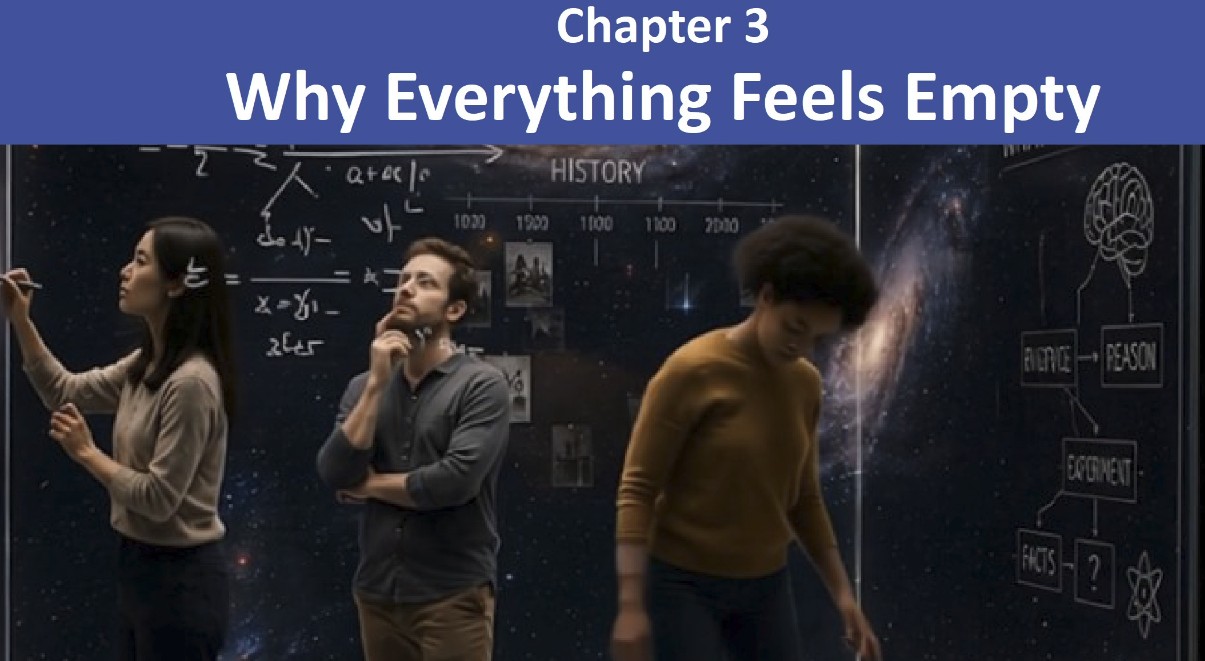
3. Why everything feels empty
Chapter 3’s thesis is: If we reject all Divine revelation we are left with four big downers — materialism, skepticism, relativism, and ultimately nihilism. We end in an intellectual and emotional abyss. Dark, dark, dark. Watch here
4A. Do our senses point to God? Is He knocking on our doors? (Part 1)
Chapter 4A presents empirical evidence — hard science — that the universe had a beginning, and challenges the materialist’s dogma that the universe is self-existent and eternal. Something besides the universe must be there. Watch here
4B. Do our senses point to God? Is He knocking on our doors? (Part 2)
Chapter 4B presents empirical evidence that natural processes cannot lead to biological life. Materialistic theories cannot explain the origin of life. Something besides random processes must have operated. Watch here
4C. Does our rationality point to God? Is He knocking on our minds?
Chapter 4C presents rational arguments that God exists. How can we explain the non-relative sense of “moral oughtness” we all experience? The universal angst of moral obligation is an effect — and it must have a cause. Watch here
5A. Reasoning for Theism historically — Jesus — Jews and Romans testify to Him
Chapter 5A reasons for theism historically — God sent His Son into our world to reveal Himself to humankind, obviously demonstrating His existence. Jesus is the sent One who testifies of God’s existence. Chapter 5A gives an overview of the life of Jesus and presents extra-biblical testimony to the historicity of Jesus. Watch here
5B. Reasoning for Theism historically — Jesus — the testimony of the “great news” books
Chapter 5B continues the historical case for theism. The historicity of the Gospel accounts — Matthew, Mark, Luke and John — and their reliability as sources are examined in detail. The conclusion reached is that the Gospels are the most highly attested historical records of any first century personage. Watch here
6A. Jesus’ challenge, “Listen to the witnesses to me!” — John the prophet and the Father
In Chapters 6A – 6D we hear Jesus defending His claims. He points us to three “witnesses” who testify that the Father sent Him. The first witness is John the prophet, the second is the Father, and the third is Moses — meaning the written law of Moses. Watch here
6B. Jesus’ challenge, “Listen to the witnesses to me!” — Prophecy fulfilled by Jesus
Chapters 6B – 6D focus on Jesus’ third and most significant witness, Moses — the written law given through Moses, the prophets, and the psalms. Chapter 6B focuses on prophecy fulfilled by Jesus. Jesus’ claim is, “The Old Testament is about Me!” Watch here
6C. Jesus’ challenge, “Listen to the witnesses to me!” — Promises fulfilled by Jesus
Chapter 6C continues with the third witness: Old Testament promises are fulfilled by Jesus’ life and ministry, death and resurrection. Jesus’ claim is, “The Old Testament is about Me!” Watch here
6D. Jesus’ challenge, “Listen to the witnesses to me!” — Jesus on display in Old Testament typology
Chapter 6D continues with the third witness: numerous Old Testament typologies — representations of what Jesus would be and do when He came. A sacrificial lamb offered to take away sin illustrates Jesus’ death as a sin offering. “Behold the Lamb of God Who takes away the sin of the world.” The Old Testament contains dozens of these typologies, and Jesus taught that they explain Him. Watch here
6E. The case for Jesus — putting it all together — the hand and the glove fit perfectly
Chapter 6E summarizes Jesus’ defense that He is who He claimed to be. The Old Testament law and prophets stitch a glove describing a coming Savior and King. Jesus is the hand which perfectly fits that glove. That being true Christian theism is highly credible. Watch here
7. When God stepped into history
Chapter 7 presents the incarnation of the Son of God — one of the biggest claims of Christianity. God becomes one of us, the ultimate act of Divine revelation. God is face to face with us, speaking to us. No one can legitimately say God is hard to find. Watch here
8. The most radical claim Jesus ever made
Chapter 8 examines nine of Jesus’ claim to epistemological lordship — that He and His words are the foundation of all true knowledge. We can know with certainty what the Divine mind has revealed through His Son. Watch here
9. The problem beneath all problems — why we’re not okay
Chapter 9 examines Jesus’ teaching on sin: humankind’s rejection of God’s authority. Our fundamental sin is the rejection of Divine revelation. Jesus said, “light has come into the world, but men loved the darkness rather than light.” Watch here
10. It’s no wonder they call Him the Savior
Chapter 10 surveys five aspects of the salvation Jesus brings: deliverance from darkness, forgiveness, emancipation from slavery to sin, being transferred from death to everlasting life, and being loved by and reconciled to the Father. Watch here
11A. Did Jesus have to die? Reconciling justice and love
Chapters 11A and 11B explore the question, did Jesus have to die? Was there another way God could save humanity without sending His Son to the cross? Chapter 11A presents four reasons why there was no other way: Moses and the prophets, the will of the Father, God’s inflexible justice, and God’s amazing love. Watch here
11B. Did Jesus have to die? Crushing the serpent’s head, freeing slaves
Chapter 11B continues to address the question, did Jesus have to die? Additional reasons why there was no other way: the one sacrifice acceptable to God, and the only way to defeat Satan and free us from bondage to sin. This chapter also discusses the power of Christ’s resurrection as the means of freeing us from slavery to sin. Watch here
12A. This is the work of God — that you believe in Him whom He sent
Chapter 12A explains that we are all called to repent and believe in the Lord Jesus, and are promised a full and free salvation when we do. Our most basic belief must be that Jesus is sent by the Father as the world’s Savior and Lord. Our most basic repentance must be receiving Divine revelation in Jesus Christ instead of rejecting it. Watch here
12B. No longer hiding and returning home — the most significant invitation you will ever receive!
Chapter 12B presents five invitations from God to us to return to Him and to reestablish our relationship with Him on the basis of His Son, Jesus Christ. The Lord Jesus assures us we will be received! “Whoever comes to me I will never cast out. This is the most significant invitation you will ever receive. ” Watch here